
[PRACTICE NOTE] Stronger Together—A Path to a Better Future for CX
[PRACTICE NOTE] Stronger Together—A Path to a Better Future for CX
REFERENCE: “The Customer Excellence Enterprise: A Playbook for Creating Customers for Life”
Synopsis. Many companies treat customer engagement, success, experience management, and customer care as separate disciplines. Each developed its frameworks, KPIs, and executive champions, operating in parallel but not necessarily in unison. That era may be coming to a close. This isn’t meant to be an alarmist provocation—given the crossroads that customer experience management and adjacent disciplines find themselves in, it’s a necessary evolution and an untapped opportunity. The fragmentation of customer-focused disciplines has left those teams vulnerable to budget scrutiny, cost-cutting measures, and flat-out elimination as CX teams from major companies continue to get blown up. Customer Excellence is a bulwark, a unifying force, bringing these disparate functions together to drive superior outcomes, not just for the company but for the customer and the professionals engaged in those functions.
In an era shaped by the forces of AI disruption, Experiential Commerce, and an unrelenting pursuit of efficiency, discrete functions such as customer engagement, customer success, customer experience management, and customer care are under intense scrutiny. Some of these disciplines are even being eliminated as organizations seek to cut costs and capture efficiencies. As a result, CX professionals, and those in adjacent disciplines, face both an existential threat and a transformative opportunity.
Customer Excellence offers a compelling path forward to seize the opportunity—one that simultaneously breaks away from and builds on the traditional orthodoxy of CX and integrates it as an accelerant within the commercial engine. This concept provides CX professionals with an unapologetically commercial interpretation of their role, aligning them directly with marketing and sales to drive the revenue performance that will always take center stage. As AI automates sentiment measurement, customer data analytics, and customer listening at scale and fundamentally reshapes how customers engage with companies, CX professionals can now expand their remit to link more directly to the tangible commercial outcomes that the C-suite and boardroom really care about. Those who embrace this shift will endeavor to no longer be incorrectly typecast as “survey people”, “journey mappers”, or “pain point finders” but as the pistons at the heart of the commercial engine.
In Service of Customer and Commercial Value
At its core, Customer Excellence isn’t just a play on words—it’s the strategic glue that binds customer engagement, success, experience management and care into a seamless new capability that exists in service of maximizing customer and commercial value. Rather than existing in silos, these functions work in concert to ensure every customer interaction—whether pre-sale, post-sale, or ongoing support—reinforces trust, strengthens brand alignment, and maximizes value. Customer Excellence aligns these disciplines under a single, intensely customer-centric mandate, transforming previously fragmented touchpoints into a cohesive capability that reduces variability and high-risk hand-offs. The unification of proactive engagement, frictionless experiences, and responsive support that are hallmarks of Customer Excellence ensures that customer expectations are consistently met, evolving preferences are anticipated, and moments of “WOW” can be interjected back into customer journeys, creating a virtuous cycle where customer satisfaction and commercial performance elevate each other.
Beyond its role in unifying customer teams, under the critical imperative to add experiential factors into offerings and value propositions as equal partners to product and brand factors, Customer Excellence serves as the connective tissue between Marketing Excellence and Sales Excellence, ensuring that the voice of the customer is not just heard but embedded into the commercial engine. Through the systematic capture and delivery of customer insights, preferences, and friction points into marketing and sales workflows, Customer Excellence enhances campaign effectiveness and sharpens the relevance of sales conversations. Rather than relying solely on internal assumptions or brand and product-led messaging, marketing teams informed by customer intelligence craft campaigns that resonate more deeply, while sales professionals engage in conversations that directly address customer needs, objections, and aspirations—turning interactions into value-driven dialogues.
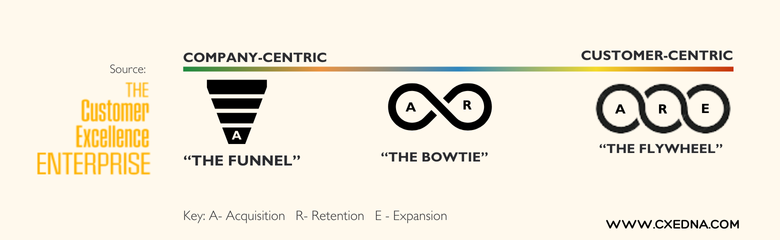
Finally, this integration transforms the traditional acquisition-centric marketing and sales funnel into a more dynamic acquisition-retention "bowtie" model, where post-sale engagement is equally weighted with pre-sale efforts. Over time, this model evolves into a full acquisition-retention-expansion “flywheel”, where customer sentiment, loyalty, and advocacy drive sustained commercial growth. In this ecosystem, marketing no longer just generates leads—it nurtures long-term relationships. Sales no longer just close deals—it opens doors to deeper partnerships.
The Disappearing Linearity of Customer Journeys
Today’s interpretations of customer engagement, success, experience management, and customer care worked well as discrete functions in an era when customer journeys were more predictable, linear, and controlled. Customers followed well-defined paths—from marketing to sales to service—allowing companies to formulate and structure customer teams independently:
- Customer Engagement teams (often housed in marketing departments) focused on meeting customers where they are, connecting to them, and giving them optionality in channel choice
- Customer Success teams ensured onboarding, adoption, and growth
- Customer Experience Management collected the voice of the customer, measured and monitored sentiment, executed targeted interventions; and
- Customer Care resolved issues as the frontline of building brand trust, attempting to turn moments of frustration into opportunities for loyalty.
In this conception, each function operated with its own metrics, technologies, and objectives, with minimal cross-functional dependency. In this structured environment, silos weren’t necessarily a flaw—they were an operational reality. However, beyond AI, things have changed—today’s omnichannel environment has shattered that linearity. Customers fluidly navigate across digital and physical touchpoints—starting an inquiry on social media, engaging via live chat, making a purchase in-store, and expecting post-sale service and support through an app or a contact center. This asymmetrical journey requires seamless, cross-functional coordination. Yet, most companies have failed to adapt, continuing to operate engagement, success, experience management, and care as independent disciplines. The result? Fragmented, high-risk handoffs, gaps, inconsistent service, and missed opportunities to build lasting customer relationships. Instead of a connected, cohesive experience, customers encounter a disjointed reality where each function sees only a piece of the puzzle rather than the full picture.
The failure to unify these disciplines is no longer just an operational inefficiency—it’s a direct threat to customer retention and loyalty. Companies that still rely on siloed structures in an omnichannel world risk frustrating their customers, eroding trust, and ultimately suffering from the downstream financial consequences that come from consistently eroding brand equity and customer goodwill. Simply put, the shift from disjointed functions to an integrated Customer Excellence model isn’t a luxury—it’s an imperative.
The Pursuit of Critical Mass
The shift toward Customer Excellence is borne out of corporate pragmatism. The truth is, when viewed in isolation, customer engagement, success, experience management, and customer care have become easy targets for budget cuts when the shifting sands of corporate priorities take hold. Companies seem to reach some mysterious inflection point, where they routinely eliminate or restructure entire departments under the guise of cost rationalization, leaving gaps that ultimately hurt the customer. But when these functions are integrated into a cohesive Customer Excellence framework, they achieve “critical mass” —a force substantial enough to elevate the customer agenda with one voice within the organization, delivering a consolidated, fortified value proposition that creates urgency and justifies continued investment -- this is the definition of how the whole really can be greater than the sum of its parts.
Customer Excellence facilitates a more coherent, critical, and collective integration with Marketing and Sales by ensuring that the customer agenda isn’t just an isolated function but a holistic, end-to-end strategy. Instead of Marketing making promises that Sales struggle to deliver—or Sales closing deals that customer success and customer care can’t fully support—Customer Excellence aligns these functions under a unified experience delivery system. This integration reduces friction, ensures consistency between brand messaging and actual customer interactions, and strengthens trust by eliminating the gaps, high-risk handoffs, and variability that siloed structures create. The result? A seamless, high-quality experience that drives stronger relationships, retention, and lifetime value.
Meeting A Customer-Driven Imperative
Instead of competing over already scarce resources, these customer teams must acknowledge that they are stronger together and weaker apart. In an age where efficiency and ROI drive resource allocation and executive decision-making, Customer Excellence provides a cohesive, strategic response to the internal debate over the value of customer-focused initiatives. The shift to Customer Excellence isn’t just about internal politics and inside baseball; it’s fundamentally about improving the way value is delivered to customers. The biggest challenge in delivering great experiences isn’t intent—it’s execution, and the persistent presence of organizational and functional silos across customer journeys and the entire lifecycle hinders that execution.
When companies attempt to deliver the customer agenda through silos, they become structurally predisposed to create friction, gaps, and high-risk handoffs that degrade the customer experience. Variability in experience delivery leads to inconsistent, poor-quality interactions, which lead to dissonance between brand promises and brand realities, frustrating customers and eroding trust. Customer Excellence is about optimizing the entire experience delivery system—not just improving individual touchpoints or segments of the customer journey but eliminating the aforementioned structural weaknesses that hinder a real opportunity to deliver seamless, high-quality experiences.
This is where the move from traditional interpretations of customer engagement, success, customer experience management, and customer care to Customer Excellence becomes a profoundly customer-centric recommitment. It forces companies to adopt an outside-in approach, where processes, teams, and technologies align to serve customer needs rather than internal organizational constraints. It prioritizes efficiency, consistency, and effectiveness—the very elements that define true excellence in experience delivery.
Transferable CX Skills for New Impact
For CX and adjacent professionals, this shift is not just about business impact—it is about career evolution. Unfortunately, too many customer-facing functions have carried cost-center status, limiting career vectors and strategic influence. However, by embracing Customer Excellence, CX professionals can redefine their core value proposition, adopt the language of commercial impact, and re-secure a seat at the executive table. CX professionals can take their toolkits directly into this game. Specifically, with their deep expertise in journey mapping, they can play a crucial role in architecting high-value campaign and engagement journeys alongside marketers. This brings a precision-driven approach to designing end-to-end engagement that seamlessly guides customers from initial awareness through purchase, retention, and advocacy.
Ultimately, rather than viewing marketing and sales interactions as isolated events, Customer Excellence ensures that marketing and sales no longer get free passes from delivering exceptional experiences—even commercial interactions can now be aligned with customer expectations, reinforcing brand trust and loyalty at every stage of the relationship. As another example of the transferability of skills, that same journey-mapping prowess extends into sales interactions, where nuanced insights into the voice of the customer fuel novel, brand-aligned engagement strategies that foster authentic connections, differentiate the brand and enhance sales conversion rates.
AI disruption is a forcing function, accelerating the need for CX professionals to pivot. Those who seize this moment will not only future-proof their careers but will also be at the forefront of shaping the next era of customer and experience-led growth. In this landscape, Customer Excellence is not a luxury—it is the key to thriving in an AI-driven, customer-centric world. The future belongs to those who recognize and embrace the idea of being stronger together.
Key Takeaways
- Many companies treat customer engagement, success, experience management, and care as separate disciplines, each with its own frameworks, KPIs, and leadership, leading to inefficiencies and missed opportunities.
- The siloed nature of these functions has made them particularly vulnerable to budget cuts, scrutiny, and even elimination, as seen with major CX team reductions in recent years.
- Customer-focused disciplines are at an inflection point where maintaining the status quo is no longer sustainable. Companies and professionals must evolve their approach or risk diminishing their ability to create value for customers.
- Integrating these functions under a single experience delivery system built around Customer Excellence creates a cohesive capability that enhances customer outcomes, business impact, and internal alignment.
- This shift is not just beneficial for the business but also for customers and the professionals working within these disciplines, as it ensures their work is more impactful, measurable, and sustainable.
Key Questions to Consider
- Are our customer-focused functions operating in alignment, or are they working in silos with separate goals and KPIs?
- How vulnerable are our customer engagement, success, experience, and care teams to budget scrutiny or elimination?
- What measurable business impact would we see by integrating these disciplines into a unified Customer Excellence framework?
- How can we restructure leadership and accountability to support a cohesive approach to experience delivery?
- What immediate steps can we take to break down silos and start building a more integrated, customer-centric operating model?
To learn more, order “The Customer Excellence Enterprise: A Playbook for Creating Customers for Life” at all major booksellers.